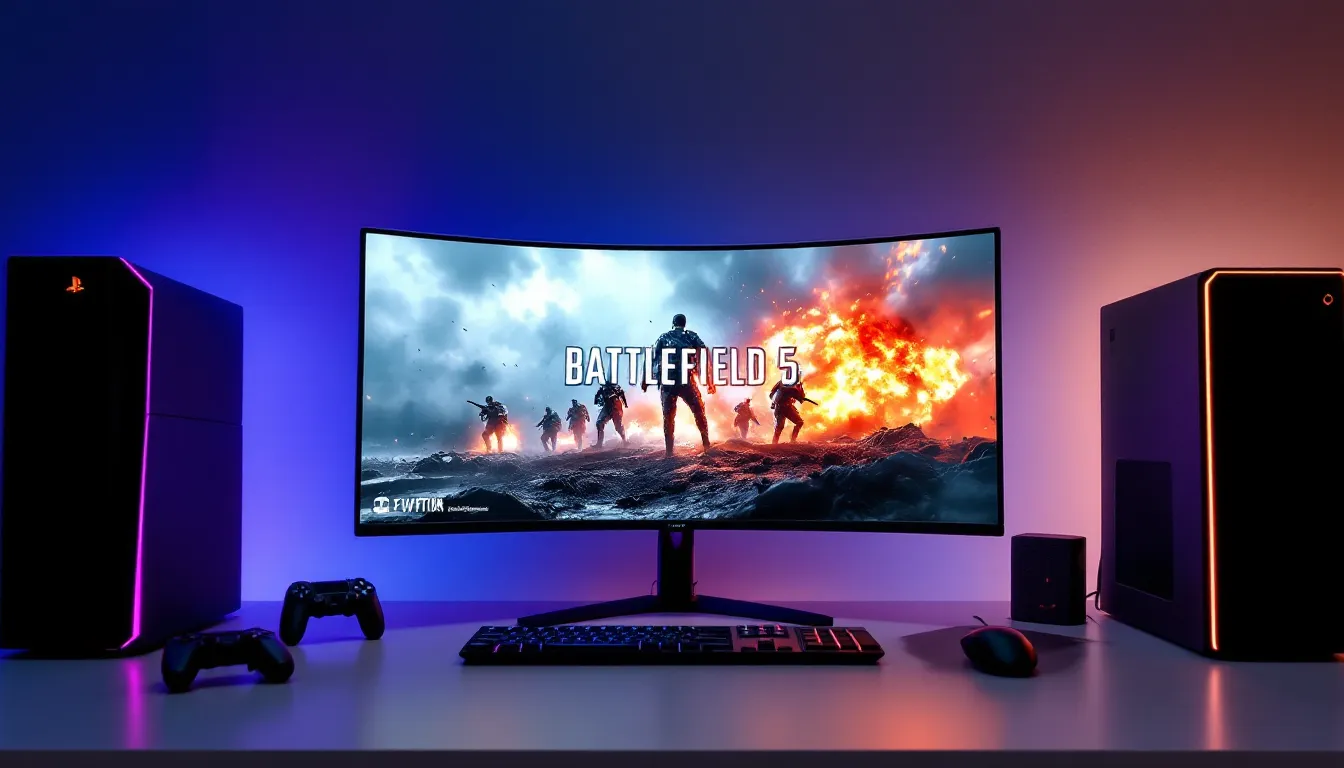
Crossplay has revolutionized how gamers connect, and Battlefield 5 stands as one of the pivotal titles that embraced this feature. Whether you’re wondering if Battlefield 5 is cross platform, looking to squad up with friends on different systems, or trying to understand how crossplay works in this iconic WWII shooter, you’ve landed in the right place. This comprehensive guide breaks down everything you need to know about Battlefield 5 crossplay in 2026, from which platforms support it to how to enable it on your system and troubleshoot common issues.
Table of Contents
ToggleKey Takeaways
- Battlefield 5 is cross platform, allowing PC, PlayStation, and Xbox players to compete together in the same matches with unified progression and cosmetics across all systems.
- Enabling crossplay is simple—navigate to Settings > Gameplay > Crossplay and toggle it on to expand your matchmaking pool and reduce wait times significantly.
- Hardware and input disparities exist in crossplay matches; PC players with high-end rigs and mouse-keyboard aiming have advantages over console players, though skill variation often overshadows these differences in casual play.
- Cross-platform squads are now possible by linking your EA account to your PSN, Xbox Live, or Steam account, enabling you to play with friends regardless of their gaming system.
- Common crossplay issues like lag can be resolved by using a wired Ethernet connection, checking server region settings, or restarting the game and toggling crossplay off and back on.
- Crossplay has become industry standard for modern multiplayer shooters, improving community unity, matchmaking speed, and long-term player retention in Battlefield 5 as of 2026.
What Is Crossplay in Battlefield 5?
Crossplay in Battlefield 5 is the ability for players on different gaming platforms to compete in the same matches. Instead of being siloed into PC-only lobbies or console-exclusive servers, you can jump into a firefight with someone playing on PlayStation while you’re on Xbox, or vice versa. This feature fundamentally changed the multiplayer landscape when it was introduced, breaking down the walls that traditionally separated player bases.
At its core, Battlefield 5 crossplay lets squads and matchmaking systems pull from a larger, unified pool of players. This means shorter wait times, more balanced skill-based matchmaking, and, most importantly, the ability to play with your friends regardless of what hardware they own. In competitive gaming circles, this has been a game-changer, as esports teams and casual squads alike can now form rosters without platform restrictions.
The implementation required significant backend work from DICE (the developer) to synchronize player progression, cosmetics, and matchmaking data across PC, PlayStation, and Xbox. Your unlocks, battle pass progress, and cosmetic skins follow you across all platforms, creating a truly unified experience.
Crossplay Support: Which Platforms Are Compatible?
PC and Console Crossplay
PC players can matchmake with PlayStation and Xbox players in most Battlefield 5 modes. This is where the real power of crossplay shines, a player grinding on their gaming PC can queue up and land in a squad with console gamers without friction. The matchmaking system doesn’t discriminate based on input method (mouse and keyboard versus controller), though some competitive settings allow you to toggle crossplay off if you prefer a level playing field against similar input devices.
One crucial note: PC performance varies wildly depending on hardware. A player on a high-end RTX 4090 rig running 144 FPS will have a different experience than someone on a mid-range system hitting 60 FPS. The crossplay system doesn’t automatically adjust for these disparities, it’s on the player to understand the potential advantages and disadvantages.
Console-to-Console Crossplay
PlayStation and Xbox players share the same matchmaking pools on Battlefield 5. Cross-generation play is also supported, meaning PlayStation 5 players can squad up with PS4 gamers, and Xbox Series X
|
S players mix with Xbox One players. The visual fidelity might differ between generations (next-gen consoles run higher frame rates and resolution), but the fundamental experience remains consistent.
This is particularly valuable for friend groups that upgraded at different times. You’re not locked out of playing with your buddy just because they haven’t picked up the new console yet.
Mobile Platform Integration
Battlefield 5 itself isn’t available on mobile, but DICE’s broader Battlefield ecosystem includes mobile titles. Mobile players exist in a separate ecosystem and don’t directly cross-play with PC or console versions of Battlefield 5. If you’re looking for a true mobile Battlefield experience with crossplay, you’d be looking at different spin-off titles, not the core Battlefield 5 experience. This remains a gap in the franchise, though the barrier between “proper” gaming devices (PC, console) has dissolved almost entirely.
How to Enable Crossplay in Battlefield 5
Crossplay Settings on PC
Enabling crossplay on PC is straightforward. Boot up Battlefield 5 and navigate to Settings > Gameplay > Crossplay. You’ll see a toggle option, flip it to On to matchmake with console players. By default, crossplay is typically enabled, but it’s worth checking your settings, especially if you previously disabled it.
If you’re worried about input device disparity (mouse and keyboard advantage in shooting games is well-documented), some regional or ranked playlists allow you to filter matchmaking. Look for any “input-restricted” playlist options in the main menu, these limit matches to similar input methods, though these playlists aren’t always active in every region.
Once enabled, your matchmaking pool expands significantly. Queue times typically drop, and you’ll see the “Crossplay Enabled” indicator in the lobby chat, confirming you’re in a mixed-platform match.
Enabling Crossplay on PlayStation and Xbox
On PlayStation 5 and Xbox Series X
|
S, the process is nearly identical. Launch Battlefield 5, head to Settings > Gameplay > Crossplay, and toggle it On. Console players will also see the crossplay indicator once a match loads, confirming you’re playing against (and alongside) PC and other console players.
For older-generation consoles (PS4 and Xbox One), the steps are the same, Settings > Gameplay > Crossplay > On. Cross-generational play is fully supported, so PS5 players will match with PS4 players and Xbox Series X
|
S will include Xbox One players in their lobbies.
One tip: if you’re in a squad with friends on different platforms, ensure everyone has crossplay enabled. If even one player has it toggled off, it can affect the entire squad’s matchmaking behavior, potentially restricting the pool.
Crossplay Options for Mobile Players
As mentioned, mobile players don’t directly participate in Battlefield 5 crossplay. If you’re playing Battlefield on mobile through a cloud gaming service (like Xbox Game Pass Cloud Gaming), you’d technically be streaming a console or PC version, so you’d fall under those same crossplay rules. Your crossplay status depends on the platform you’re streaming from, not your mobile device itself.
For anyone exclusively on mobile, alternative Battlefield titles designed for smartphones exist, but they operate in separate ecosystems entirely.
Crossplay Matchmaking and Performance Implications
How Crossplay Affects Matchmaking
Crossplay fundamentally expands your matchmaking pool. Instead of waiting 2–3 minutes for a PC-only match in a niche region, you’re instantly pulling from millions of players across all platforms worldwide. This is especially noticeable during off-peak hours or in less-populated regions. The SBMM (skill-based matchmaking) system now has a much larger talent pool to draw from, theoretically creating more balanced and competitive matches.
But, this expansion comes with trade-offs. You might encounter players with wildly different hardware capabilities. A console player on a PS5 hitting 120 FPS will have snappier input response than a PS4 player locked at 60 FPS, even though they’re both on PlayStation. Regional matching can also be affected, you might end up playing against someone on the opposite side of the globe, introducing network latency that impacts gameplay.
The matchmaking also doesn’t account for input device differences algorithmically. A mouse-and-keyboard PC player has objectively faster tracking and flick shots compared to a controller user. Some competitive players argue this creates unfair advantages, though in casual matchmaking, skill variation overshadows input method differences.
Performance and Frame Rate Considerations
Frame rate isn’t equalized across platforms. A PC player running Battlefield 5 at 165 FPS on a high-refresh monitor has a tangible advantage in responsiveness compared to a console player at 60 FPS (or even 120 FPS on PS5/Xbox Series X). This is one of the criticisms leveled at crossplay, the hardware advantage isn’t neutralized.
Console players benefit from frame rate boosts on newer-generation systems. PS5 and Xbox Series X support up to 120 FPS in performance mode, which is a significant jump from the PS4’s 60 FPS cap. PC players, meanwhile, can scale to whatever their hardware allows, some competitive players hit 240+ FPS for competitive advantage.
Latency (ping) also varies. A player with a wired connection and 20ms ping will have a smoother experience than someone on WiFi with 80ms ping. Crossplay doesn’t account for this either. The net result is that Battlefield 5’s crossplay experience is inclusive but not perfectly fair, everyone can play together, but hardware and connection quality still matter tremendously. If you’re competitive, investing in a better monitor, lower ping internet, or upgrading your console generation pays tangible dividends.
Advantages and Disadvantages of Playing Crossplay
Benefits of Crossplay in Battlefield 5
The primary advantage is community unity. Crossplay shattered the walls separating PC, PlayStation, and Xbox players. Friend groups no longer need to buy multiple copies of the game or coordinate who owns what platform, you can all jump in together. This is huge for casual gaming and streaming communities where viewers might play on different systems.
Matchmaking speed is another huge win, especially for less-popular modes. Instead of waiting 5+ minutes in a niche playlist, you’re pulling from a global pool. This keeps matches populating quickly and keeps gameplay fresh across all regions.
Longevity and player retention also improve. When the playerbase feels unified rather than fragmented, the game feels more alive. Fewer dead playlists, more populated servers, and a stronger sense of a living, breathing community. This is directly tied to Battlefield 5’s continued viability in 2026, crossplay is part of why the game still has an active playerbase years after launch.
For competitive players and esports, crossplay opens team-building possibilities. Rosters aren’t limited by platform affiliation anymore. A skilled player on any system can join a competitive squad.
Potential Drawbacks and Challenges
The hardware disparity is the elephant in the room. PC players with high-end GPUs, faster CPUs, and high-refresh monitors have objective advantages. Mouse-and-keyboard aiming is measurably faster than controller aiming. Console players transitioning from platform-exclusive matches suddenly face these disparities head-on.
Input device inconsistency creates fairness concerns. Some players argue that crossplay should restrict mouse-and-keyboard players to PC-only queues, but this fragmentizes the playerbase again. It’s a lose-lose: either accept the hardware/input advantage, or rebuild the walls that crossplay tore down.
Latency and connection quality aren’t equalized. A player with fiber internet at 15ms ping will consistently outshoot a player on WiFi at 60ms ping, regardless of platform. Crossplay doesn’t solve this, and it becomes more apparent in longer-range gunfights.
Toxic behavior can spread more easily when communities blend. Console players and PC players have historically had different cultural norms around communication and competition. Crossplay means more diverse matchmade groups, which can create tension if players have incompatible expectations.
Finally, skill gaps might feel wider. In a PC-only lobby, everyone’s roughly on equal footing hardware-wise. In a crossplay match, skill differences are magnified because you’re unsure whether you lost a gunfight due to opponent skill or their superior equipment. This can feel frustrating for console players getting rolled by high-end PC rigs.
Common Crossplay Issues and Troubleshooting
Connection and Lag Problems
Lag during crossplay matches often stems from regional mismatching or poor internet quality. If you’re consistently experiencing stutters or rubber-banding, first check your ping using your console’s or PC’s network diagnostics. Anything under 50ms is ideal: 50–100ms is playable: above 100ms becomes noticeably sluggish.
If your ping is high, try:
- Wired connection: WiFi introduces latency variance. Plugging directly into your router via Ethernet is the single biggest fix for lag.
- Regional preference settings: Some games let you restrict matchmaking to nearby servers. Check Battlefield 5’s network settings for server region filters.
- QoS settings on your router: Prioritize gaming traffic to reduce packet loss and jitter.
Crossplay matches sometimes pull from geographically distant servers to populate matches quickly. If lag is unbearable, toggling crossplay off (if you’re okay with longer wait times) forces matchmaking to regional PC or console-only servers, which might be geographically closer.
Crossplay Not Working: Solutions and Fixes
If crossplay isn’t functioning:
1. Verify it’s enabled: Navigate to Settings > Gameplay > Crossplay and confirm it’s toggled On. This sounds basic, but it’s often the culprit.
2. Check for updates: Ensure Battlefield 5 is fully updated. Outdated game versions sometimes have crossplay bugs. Check your platform’s store for pending updates.
3. Restart the game and console: Power cycle your system. Close Battlefield 5 entirely, restart your console, and relaunch. This clears network caches and often resolves connectivity hiccups.
4. Verify your account is linked: Crossplay relies on your EA account being connected to your platform account (PSN, Xbox Live, or Steam/Origin for PC). Check that your accounts are linked in the EA settings.
5. Check server status: Visit EA’s official server status page or check gaming news outlets like IGN for reports of widespread outages. Sometimes crossplay servers experience maintenance.
6. Disable and re-enable crossplay: Toggle crossplay Off, restart the game, toggle it Back On, and restart again. This forces a fresh connection to crossplay infrastructure.
7. Port forwarding (for PC): If you’re on PC and nothing else works, your router might be blocking connections. Research UPnP enablement or port forwarding for Battlefield 5 (typically requires opening ports 3074 and 3478 for EA’s services). This is advanced but sometimes necessary.
If crossplay is fully broken across your account and nothing fixes it, you might have a corrupted local save or account-level issue. Contact EA Support, they can reset your crossplay configuration.
Crossplay Friend Groups and Squad Building
One of the most game-changing aspects of Battlefield 5 crossplay is the ability to squad up with friends regardless of platform. Your friend group is no longer limited by hardware fragmentation, the squad leader can have a PC player, two PS5 players, and an Xbox player, all dropping into the same match together.
To add friends across platforms, use your EA account. Link your PSN, Xbox Live, and Steam/Origin accounts to your EA account (in your EA settings), and you can search for friends by their EA username. Once added, you’ll see them in your friends list in-game, and you can invite them to squads directly.
Key tips for cross-platform squads:
- Voice communication: Use your platform’s party system (Discord, PlayStation Party, Xbox Live Party) or in-game voice chat. All platforms support cross-platform voice, though in-game Battlefield 5 chat can be spotty. Discord is the most reliable for squad comms.
- Squad dynamics: Remember that console players might feel disadvantaged against high-end PC hardware. Lead with skill callouts and tactical coordination rather than assuming mechanical superiority.
- Progression parity: Everyone’s battle pass progress and cosmetics sync across platforms, so there’s no catch-up penalty for squad members on different systems.
- Playstyle awareness: PC mouse-and-keyboard players often excel at longer-range engagements (sniping, DMR spam), while controller players gravitate toward close-quarters CQB where aim assist helps. Build squads with this in mind.
Cross-platform squads are the future of gaming. Battlefield 5 made this accessible, and it’s become table stakes for modern multiplayer shooters.
Future of Crossplay in Battlefield Titles
Crossplay is now a foundational expectation for Battlefield and similar large-scale multiplayer shooters. DICE’s commitment to crossplay in Battlefield 5 set a precedent for all future titles in the franchise. As we move into 2026 and beyond, expect crossplay to be standard, not optional, in Battlefield 2042 and whatever comes next.
The industry is moving toward even more ambitious cross-ecosystem integration. Cloud gaming services like Xbox Game Pass Cloud Gaming and PlayStation Plus Premium are blurring hardware lines further. A player on any device capable of streaming might soon jump into matches alongside traditional console and PC players seamlessly.
But, challenges remain. The hardware advantage for high-end PCs is unlikely to disappear, it’s inherent to technology. Future Battlefield titles might carry out input-restricted playlists (controller-only, mouse-and-keyboard-only) more aggressively, or level the playing field with stricter frame rate/latency handicaps. Recent gaming industry reports suggest developers are exploring matchmaking algorithms that account for hardware specs more intelligently.
Mobile crossplay is the next frontier. As mobile gaming becomes more sophisticated, true cross-platform play from smartphone to PC to console could become reality. Battlefield 5 didn’t crack this, but future titles might.
For now, Battlefield 5’s crossplay remains one of the gold standards. It proved that unifying a fragmented playerbase is possible and beneficial. Any gamer considering jumping into Battlefield 5 in 2026 should embrace crossplay, it’s a feature that makes the game better, not worse, even though its trade-offs. The larger community, faster matchmaking, and ability to play with friends on any system are worth the occasional hardware disparity.
Conclusion
Battlefield 5 is absolutely cross platform, and that’s one of its defining strengths in 2026. From PC to PlayStation to Xbox, the game unites players in a way that traditional exclusive playlists never could. Enabling crossplay is simple, just toggle it on in settings, and the benefits (faster matchmaking, larger friend groups, unified progression) far outweigh the drawbacks (hardware disparity, latency variation).
Understanding how crossplay works, troubleshooting connection issues, and building cross-platform squads are now essential skills for modern gamers. The era of platform-exclusive communities is fading. Crossplay isn’t the future, it’s the present. Whether you’re a casual player looking to squad up with friends or a competitive gamer chasing rank, Battlefield 5’s crossplay ecosystem delivers.
If you want deeper dives into Battlefield 5’s mechanics, player counts, or game status, Droprift’s comprehensive guides on crossplay and community health provide additional context for optimizing your Battlefield 5 experience across all platforms.