Masterwork armor stands as one of RuneScape‘s most rewarding endgame grinds. Whether you’re pushing high-level PvM content or just want to flex in Falador, crafting your own masterwork set feels like a legitimate achievement, and the armor backing it up delivers serious stats to match. This guide walks you through everything: from meeting the brutal skill requirements to optimizing your setup with perks and augmentations. We’ll cover the economics of crafting versus buying, maintenance costs that won’t drain your bank, and the mistakes players constantly make that waste time and resources. If you’re serious about dominating with masterwork armor, you’ve got the right roadmap.
Table of Contents
ToggleKey Takeaways
- Masterwork armor is a tier 90 melee set that never degrades to nothing, offering sustainable endgame protection for 2–4M per hour in repair costs compared to Torva’s 30M+ hourly upkeep.
- Crafting masterwork armor requires 99 Smithing, 80 Crafting, and approximately 9,000 metal bars plus 100 elder god bones, making it a time-intensive but rewarding achievement that teaches genuine resource management.
- Masterwork maintenance is budget-friendly with a 100,000 durability pool per piece; repair proactively at 50% durability, use perks like Cherishable to reduce degradation costs, and combine it with tier 90 weapons for balanced DPS.
- The true profit of masterwork armor lies not in crafting it (which loses money) but in using it to unlock higher-income boss content like Sanctum and Kerapac, which earn significantly more GP per hour than tier 65 alternatives.
- Avoid common mistakes like augmenting immediately before testing the playstyle, ignoring durability warnings, pairing the armor with weak weapons, or forcing it into content that demands Torva’s superior tier 92 stats.
What Is Masterwork Armor and Why Players Need It
Masterwork armor is tier 90 melee armor, and it’s one of the few craftable sets at that level. Unlike most high-tier gear that requires RNG drops from bosses, you can forge masterwork entirely through smithing, no luck involved. That’s a massive quality-of-life factor for players who want control over their progression.
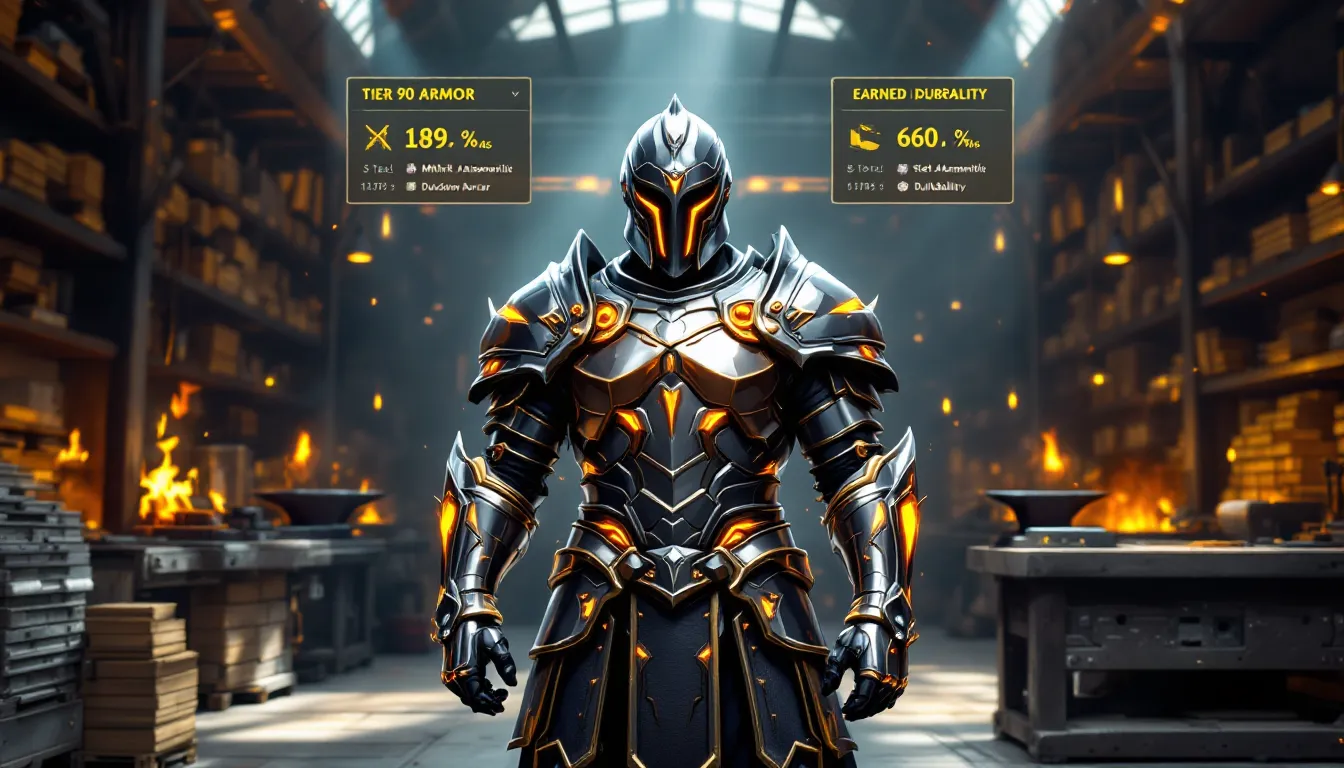
The armor comes in a few forms: heavy masterwork, glorious masterwork (which you forge), and trimmed masterwork (decorated version with identical stats). Stats-wise, masterwork sits at tier 90 for both damage and defense, making it competitive with top-tier melee armor like Torva or Bandos. The critical difference: masterwork doesn’t degrade into nothingness. Instead, it has the unique Trim mechanic, meaning you can repair it indefinitely without losing the item.
Why should you care? If you’re grinding high-level PvM like GWD2, Nex, or even mid-tier Sanctum content, masterwork keeps you protected without the soul-crushing costs of tier 90 armor that disintegrates. The crafting requirement also gates it behind actual gameplay: players who put in the work own their achievement instead of relying on RNG. For casual and hardcore players alike, that resonates.
Requirements and Prerequisites for Crafting Masterwork Armor
Before you start hammering bars, know the wall in front of you. Masterwork armor has some of the toughest crafting requirements in the game, and skipping this section will cost you time and money.
Smithing and Crafting Skill Requirements
First, the big one: you need 99 Smithing. Not 95. Not 98. Ninety-nine. That’s non-negotiable for crafting glorious bars, which are the base material for masterwork armor. There’s no way around it, no items boost smithing for this task, and no hard mode shortcut exists.
You also need 80 Crafting minimum to smith glorious bars, though that feels almost trivial once you’re at 99 smithing anyway. The real bottleneck is smithing. If you’re not there yet, plan for a grind of 150+ hours starting from level 70-80, depending on your training method and whether you’re doing it profitably or just pushing for 99.
Materials Needed for Full Sets
A complete masterwork armor set requires a ton of materials. Here’s what one set demands:
- 3 glorious bars (the cornerstone)
- 1 masterwork plate (crafted separately)
- 900 steel bars for the forge (to create glorious bars)
- 900 mithril bars (same)
- 900 adamantite bars (same)
- 900 runite bars (same)
- 100 elder god bones (dropped by Kerapac or similar high-level bosses)
All told, you’re looking at roughly 9,000 total metal bars plus 100 elder god bones just for one complete set. The cost? Expect 35–45 million GP if you’re buying materials from the GE. If you’re gathering them yourself through mining, plan for several hundred hours. Most players buy the bars and focus on the smithing grind instead. That’s not lazy, that’s efficient.
Step-by-Step Crafting Process
Crafting masterwork is methodical. There’s no rushing it, so understanding the pipeline keeps you sane.
Obtaining Glorious Bars
Glorious bars are the bottleneck. You create them by smelting four bars of different metals (steel, mithril, adamantite, runite) simultaneously in a furnace. This is an all-or-nothing mechanic, if you’re missing even one bar type, the smelt fails and you lose nothing, but you gain nothing either. Make sure you have stacks organized before you start.
The best place to do this? Head to a furnace near a bank, Falador, Port Phasmatys, or Al Kharid all work. Load up your inventory with 14 sets of all four metal bar types (56 bars total: 14 steel, 14 mithril, 14 adamantite, 14 runite). Smelt them one at a time. Each glorious bar takes about 6 seconds, so you’re looking at ~90 seconds per inventory cycle. For 3 glorious bars per armor set, you’re talking a lot of furnace time if you’re crafting multiple sets.
Smelting and Forging Techniques
Once you have glorious bars, you move to the anvil at the Varrock Anvil or other high-tier smithing locations. This is where the actual “crafting” happens in a traditional sense.
For glorious bars, you use them with the anvil and select the specific body part: legs, chest, gloves, boots, helmet. Each piece requires a glorious bar plus some steel bars. The exact recipe per piece:
- Chest plate: 1 glorious bar + 5 steel bars
- Helmet: 1 glorious bar + 5 steel bars
- Legs: 1 glorious bar + 5 steel bars
- Gloves: 1 glorious bar + 3 steel bars
- Boots: 1 glorious bar + 3 steel bars
You need 99 smithing to attempt any of these. The success rate is 100% at 99 smithing with no way to fail (unlike lower-level smithing). Each piece takes roughly 5 seconds to forge, so a full set body takes maybe 25–30 seconds total.
Assembling Your Complete Set
After forging all five pieces, you’re not done. You need the masterwork plate body, which is a separate component. You craft this at the Anvil using glorious bars in a special recipe, and it serves as the “base” that holds the set together.
Once you have all pieces plus the masterwork plate, go to the Workbench at Varrock or another crafting station. Combine everything using the Artisan’s Workshop or the Masterwork armor set option. This final assembly binds them into a tradeable, wearable set. From there, you’ve got your armor ready to equip or sell.
Stats, Benefits, and Combat Performance
Now that you’ve got the armor, let’s talk about whether it was worth the grind.
Armor Tier and Damage Reduction
Masterwork armor provides tier 90 melee armor stats, which means:
- Ranged defense: +86
- Magic defense: +12
- Melee defense: +130+ (varies by piece)
- Damage reduction: Approximately 10–12% flat damage reduction for physical attacks
The “trim” doesn’t change stats, it’s purely cosmetic. The unique trait: masterwork doesn’t degrade into nothingness. Instead, it slowly loses durability and requires repair via the Repair Anvil using glorious bars. More on that later.
In raw survivability terms, masterwork sits between Bandos armor (tier 65, much cheaper but lower defense) and Torva armor (tier 92, better stats but brutal degradation costs). For endgame PvM, masterwork gives you tier 90 protection at a fraction of Torva’s upkeep cost.
Comparison With Other Late-Game Armor Options
Let’s be real: how does masterwork stack up?
Versus Torva (Tier 92): Torva has +2 tier advantage, meaning slightly higher defense and damage reduction. But, Torva costs 30–50M per hour to maintain and eventually degrades to dust. Masterwork costs 2–4M per hour to maintain indefinitely. If you’re grinding for 50+ hours, masterwork wins financially.
Versus Bandos (Tier 65): Bandos is dirt cheap and lasts forever (no degradation). But tier 65 gets noticeably shredded by tier 92+ bosses. At that point, you’re taking extra damage that costs supplies and time. Masterwork’s tier 90 is the sweet spot for GWD2 and mid-tier Sanctum without the financial bloodshed of Torva.
Versus Cryptbloom (Tier 80 Magic): Not comparable, this is melee armor. But worth noting that Cryptbloom occupies a similar “endgame but affordable” space for mages.
The verdict: masterwork is the “smart” choice for players who value sustainability. Elite PvMers farming Nex or Zamorak might prefer Torva’s raw stats, but for consistent grinding, masterwork’s math works.
Repair, Maintenance, and Degradation
Masterwork’s magic lies in its repair mechanic. Instead of degrading into nothingness, it degrades to a broken state and can be repaired indefinitely.
Durability Mechanics and Costs
Masterwork armor has a durability pool. Each piece has roughly 100,000 durability (the exact number varies slightly per piece). As you deal and take damage in combat, durability drains. Heavy combat, boss fights, especially, eats durability fast. Light training or PvP uses it slower.
Once durability hits zero, the armor becomes “broken” and cannot be equipped. It doesn’t disappear: it sits in your inventory as a broken item. To repair it, head to any anvil and use the piece with the anvil while holding glorious bars. Each glorious bar restores 10,000 durability.
Cost calculation: A single glorious bar runs about 25,000–35,000 GP on the GE (prices fluctuate). Repairing a full set’s durability costs roughly 2.5–4M GP per 100,000 durability per piece. If all five pieces are broken, expect a 10–20M repair bill. That sounds brutal until you realize Torva costs 30M+ per hour of PvM and you’re earning 3–5M per hour at mid-tier bosses. The math heavily favors masterwork for anything sub-elite.
Best Methods for Cost-Effective Upkeep
Here’s where efficiency matters:
1. Repair before degrading fully. Repairing at 50% durability is cheaper than waiting until it’s broken. Broken items can’t be equipped, so you lose time swapping gear. Repair proactively.
2. Use a Crystal Saw (Crafting boost). Wearing a Crystal Saw and drinking Crystal Elixir while repairing gives a 10% durability boost. It’s not massive, but it compounds over hundreds of hours.
3. Augment for Perks. Augmented masterwork can use the Cherishable perk, which reduces degradation by 5%. It’s not game-changing but adds up. More on perks later.
4. Combine with gear switches. In harder PvM, swap to lower-tier armor for low-damage phases. Masterwork is strong but overkill for some encounters. Swapping to Bandos for 30 seconds saves durability.
5. Train alt combat skills while maintaining. If you’re maintaining masterwork as a break from grinding, you’re not “wasting” time. Treat repairs as downtime between sessions.
Money-Making Strategies and Cost Efficiency
Here’s the uncomfortable truth: crafting masterwork is not profitable. It costs more in materials than the finished armor sells for. But that’s not the real question. The real question is: how do you make the money to afford the grind, and once you own masterwork, how do you leverage it to earn?
If you’re starting from scratch with minimal gold, don’t craft masterwork yet. Instead, focus on money-making first. Activities like Archaeology (passive, 2–4M per hour), Vorkath (PvM, 4–6M per hour with decent gear), or Herblore flipping (merching, variable) can fund the 40–50M material cost. Once you’ve banked that, then commit to the smithing grind.
Once you own masterwork, the armor pays for itself indirectly. You can grind harder content with lower total cost per hour. GWD2 runs are noticeably cheaper per hour with masterwork than with cheaper alternatives because you take less damage and use fewer supplies. Sanctum of Sin on tier 1–2 becomes accessible, and those encounters drop solid loot. Kerapac the Wretched becomes farmable for alchable drops and unique weapons.
The indirect profit is substantial if you factor in hourly GP/hour at boss content you can access with masterwork but couldn’t efficiently handle with lower-tier gear. Don’t think of masterwork as an investment, think of it as a tool that unlocks higher-income content. The “profit” is the difference between what you earn at tier 90 boss content versus tier 65 content, multiplied by the hours you grind. Over 200+ hours, that’s tens of millions of difference.
One more angle: if you’re a hardcore PvMer, you might consider buying masterwork rather than crafting. A complete set costs roughly 35–50M to craft but only 70–90M to buy finished on the GE. The 35M difference is worth it if your time is better spent grinding bosses than smelting bars. For casual players, the crafting journey is part of the appeal.
Advanced Tips for Optimizing Your Masterwork Setup
Masterwork is strong out of the box, but there are layers of optimization that separate casual wearers from veterans.
Perks and Augmentation Options
Masterwork armor can be augmented at a workbench, consuming a chunk of progress but unlocking perk slots. Once augmented, you can add perks using the Invention skill.
Top perks for masterwork:
- Cherishable: Reduces degradation by 5%. Not flashy, but it saves money.
- Impious: Grants a flat 1% damage increase. Stacks if you have it on multiple pieces.
- Venomblood: Prevents poison and venom damage. Situational but essential for some bosses.
- Crackling: Deals periodic damage based on damage taken. Good for tanky setups where you’re absorbing hits.
- Devoted: Grants a chance to convert incoming damage to prayer points. Powerful for survivability.
The best loadout depends on content. For GWD2, stack Devoted and Crackling on chest and legs. For Sanctum, use Cherishable and Impious to reduce cost while maintaining damage. For Kerapac, Venomblood is almost mandatory on at least one piece.
Augmenting itself costs 10M GP per piece and consumes the original item, so do this only after you’re confident you’ll main that armor. First-timers should stick with unaugmented masterwork until they’ve earned the gold and confirmed the combat style.
Combining Masterwork With Other Gear
Masterwork isn’t worn in a vacuum. The best setups combine it with complementary gear based on your slot and content.
Weapon slots: Pair masterwork with tier 90 melee weapons like Khopesh of Mej or Zaff’s Hasta. These add the final DPS layer needed for efficient bossing. Don’t wear tier 80 weapons with tier 90 armor, it’s imbalanced.
Gloves: Swap to Barrows gloves for consistency, or upgrade to Torva gloves (tier 92) if you’re running high-end PvM. Masterwork gloves are solid but not a bottleneck.
Boots: Ragefire boots or Bandos boots are budget options. Torva boots are a marginal upgrade if you’re going for maximum DPS.
Cape slot: Max cape for the stats, or a combat cape like Ava’s Assembler (range) or Infernal cape (if you’re that person).
Ring: Ring of Wealth for loot, Berserker Ring for DPS, or Recoil Ring for tanking. Context matters.
The synergy principle: your armor sets the tank baseline: everything else boosts damage or utility. Don’t overspend on a ring if your weapon is weak, and vice versa. Balance matters more than individual item tiers. You can also money-making strategies in RuneScape to fund these upgrades efficiently.
Common Mistakes and How to Avoid Them
Players wreck themselves on preventable errors. Here’s what to watch for.
Mistake 1: Grinding 99 smithing without understanding the cost. Some players push to 99 smithing then realize they need 40M in bars. If you’re training smithing, do your math first. Buy materials in bulk before you start. Fluctuating GE prices will wreck unprepared players.
Mistake 2: Crafting multiple sets without a plan. Masterwork is a grind, not a money maker. Crafting five sets “just in case” is a waste of resources. Craft one, master it, and only make another if you’re genuinely going for backup gear or a different build.
Mistake 3: Not planning repair costs. Some players craft masterwork then panic when repairs cost 15M. Budget for maintenance. It’s part of ownership. If you can’t afford to repair, you can’t afford to use it.
Mistake 4: Augmenting immediately. Augmenting locks the item and costs 10M. New masterwork owners should wear unaugmented for 50+ hours first, confirm they like the playstyle, then augment. Don’t rush it.
Mistake 5: Ignoring durability warnings. RuneScape gives clear warnings when durability is low. Some players ignore them and suddenly can’t equip their armor mid-dungeon. Proactively repair. It takes 5 minutes and saves an entire session.
Mistake 6: Pairing masterwork with weak weapons. Wearing tier 90 armor with tier 70 weapons is like buying tires for a Ferrari and using a Honda engine. The DPS imbalance wastes time and supplies. Match your weapon tier to your armor tier.
Mistake 7: Not accounting for content difficulty. Masterwork is strong, but it’s not Torva. Some bosses demand Torva’s extra tier for acceptable kill times. Don’t try to force masterwork into Zamorak if you’re not ready. Know your limits: there’s no shame in stepping back. Resources like GamesRadar+ and Game Rant have detailed boss guides that can help you assess whether masterwork is sufficient for your target content.
Conclusion
Masterwork armor is a earned achievement. It demands 99 smithing, millions in materials, and dozens of hours at the anvil. But once you own it, you’ve unlocked a sustainable, powerful tool that opens entire tiers of PvM content without the financial bloodshed of Torva or the limitations of budget gear. The crafting journey teaches you resource management, the repair system teaches you long-term planning, and the armor itself teaches you what genuine endgame looks like in RuneScape. Whether you’re grinding to own the armor yourself or buying finished pieces from the GE, masterwork represents a threshold moment in your RuneScape career. You’re no longer playing with training wheels: you’re ready for the real grind. Start planning your 99 smithing push today, and in a few months, you’ll be standing in a boss arena wearing something you actually made. That’s the magic of masterwork.