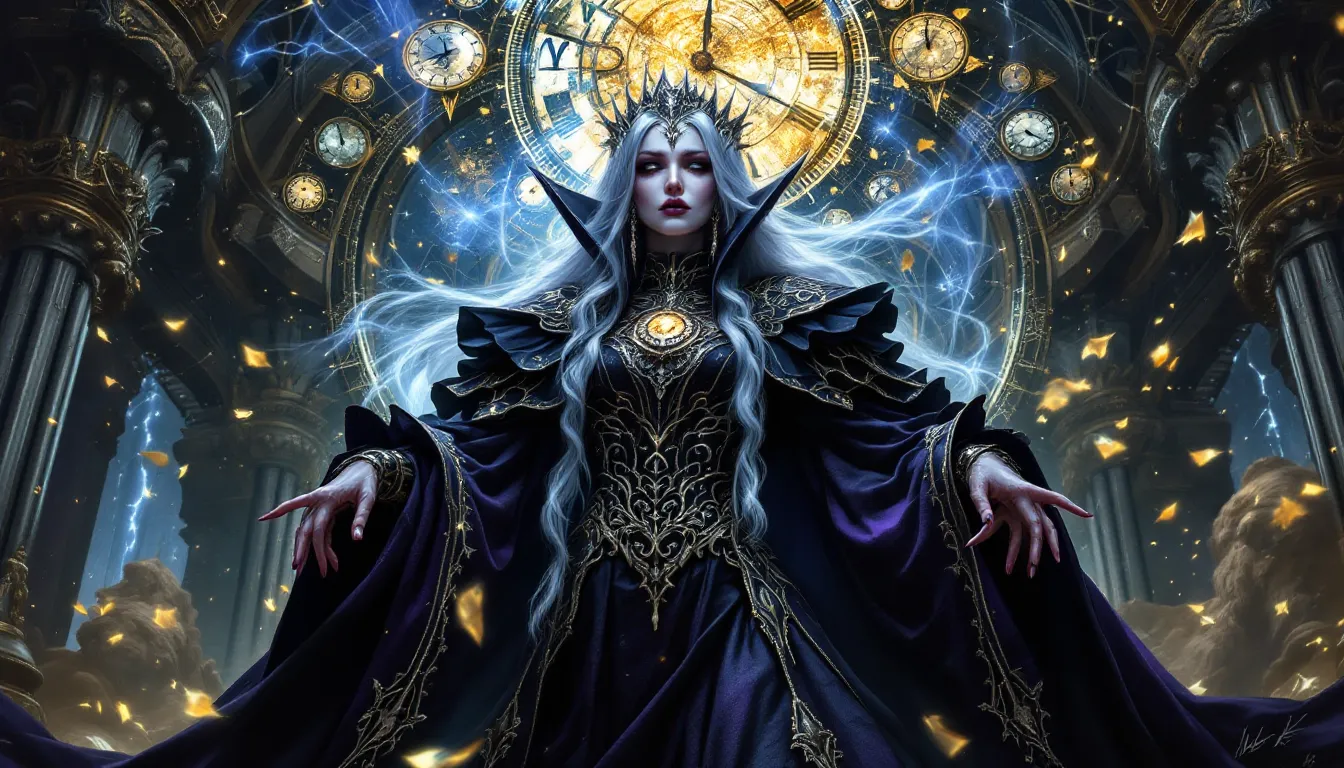
When you think of iconic Final Fantasy villains, certain names come to mind immediately: Sephiroth, Kefka, Ardyn. But there’s one sorceress who doesn’t get enough credit for her complexity and sheer ambition, Ultimecia from Final Fantasy VIII. She’s not just another final fantasy ultimecia antagonist throwing around destructive magic: she’s the architect of a time-spanning conspiracy that redefines what it means to be a villain in the franchise. Released in 1999, FF8 gave us a protagonist in Squall who matched her in emotional depth, creating one of the most psychologically compelling rivalries in gaming history. Whether you’re revisiting Final Fantasy VIII for nostalgia or discovering it for the first time, understanding Ultimecia is key to appreciating one of the series’ most ambitious narratives.
Table of Contents
ToggleKey Takeaways
- Ultimecia from Final Fantasy VIII transcends typical villain archetypes by existing across multiple timelines and seeking to compress all time into a single moment under her control, making her one of the franchise’s most philosophically complex antagonists.
- Her descent into villainy stems from centuries of persecution and discrimination, driving her to pursue existential horror rather than simple conquest—she wants to escape suffering by erasing the concept of time itself.
- Defeating Ultimecia requires strategic preparation including balanced team composition, proper junction setups, and phase-specific tactics that prioritize healing during her devastating Time Compression ability.
- Final Fantasy VIII’s narrative structure, built around Ultimecia’s time manipulation, pioneered storytelling techniques that influenced modern games and established her as a foundational character in discussions about complex video game antagonist design.
- Ultimecia’s character remains relevant today because her themes of isolation, desperation, and radicalization driven by systemic persecution resonate with contemporary conversations about trauma and marginalization in gaming narratives.
Who Is Ultimecia?
The Sorceress of Legend
Ultimecia exists in Final Fantasy VIII’s lore as a sorceress of terrifying power, one who transcends the boundaries of time itself. She’s not bound by the present: she operates across multiple timelines and ages, making her more than just a villain. She’s a concept, a force of will that persists beyond normal death and causality. In the world of FF8, sorceresses are rare, feared, and often hunted. Ultimecia represents the apex of this persecution, a sorceress so powerful that kingdoms rose and fell trying to contain her.
What makes her different from typical Final Fantasy villains is her motivations aren’t rooted in megalomania or a desire to reshape the world into some utopian vision. Her goals are darker, more primal. She wants to compress all time into a single moment under her control, essentially creating a frozen eternity where she reigns supreme. It’s existential horror dressed up as cosmic-scale ambition.
Her Role in Final Fantasy VIII
In FF8, Ultimecia operates from the shadows for much of the game’s narrative. You’re hunting her across time, but she’s simultaneously hunting you. The game’s structure, where you’re moving backward through time to confront her, is her influence warping reality itself. Squall Final Fantasy: The becomes her primary target because of his connection to Rinoa and the chain of events that creates her existence.
The brilliance of FF8’s narrative is that Ultimecia isn’t the final obstacle because she’s merely defeated, she’s the final obstacle because understanding her means understanding Squall’s own internal struggle. The game uses her as a mirror, reflecting themes of isolation, desperation, and the crushing weight of responsibility. By the time you face her in the game’s final sequences, you’re not just fighting a boss: you’re confronting the culmination of fate itself, shaped by her will and her obsession with absolute control.
Understanding Ultimecia’s Complex Motives
Revenge and Persecution
Ultimecia wasn’t always a cosmic tyrant. Her descent into villainy starts with persecution. Throughout FF8’s world, sorceresses face fear, discrimination, and violence. Ultimecia experienced centuries of this hatred, hunted across ages, her powers feared, her very existence treated as a plague upon humanity. This isn’t her being paranoid: it’s her drawing rational conclusions from repeated trauma.
What separates her from other antagonists is that her revenge isn’t merely personal. She doesn’t want to destroy those who wronged her: she wants to erase the very concept of time that allowed her suffering to occur. If all moments collapse into one, then the persecution never happened and never will happen. It’s a twisted form of mercy disguised as apocalypse. She’s not trying to conquer, she’s trying to escape, and she’s willing to unmake reality to do it.
Time Manipulation and Her Grand Design
Ultimecia’s master plan operates on a scale that makes most Final Fantasy villains look small. She doesn’t just want to rule the present: she engineers events across centuries to ensure her existence and power. She sends herself back through time, creating a causal loop where her influence shapes the very events that create her. Final Fantasy Omega: The represents a similar concept of ultimate power, but Ultimecia goes further, she actively rewrites timelines.
The mechanic of time compression, her ultimate ability, isn’t just a spell. It’s a rejection of linear existence itself. By compressing all of time into a single point (the “Sorceress Ultimecia” moment), she achieves godlike status. Every moment, every possibility, every version of every timeline exists simultaneously under her absolute dominion. It’s the ultimate form of control for someone who spent her entire existence powerless. This design choice makes her narrative arc far more sophisticated than simple world domination. She’s redefining what existence means according to her will.
Ultimecia’s Abilities and Powers
Time Magic and Reality Warping
Ultimecia’s magic doesn’t follow traditional spellcasting rules. She commands Demi, Apocalypse, The Legendary Guardian Force, and most devastatingly, her signature ability Time Compression. Unlike typical magic that affects the battlefield or individual targets, her spells manipulate the fundamental fabric of existence.
Apocalypse summons meteors to devastate targets with non-elemental damage, thematic and devastating. Demi cuts enemy HP by half, ignoring traditional defense mechanics. But the real threat is The Legendary Guardian Force, a colossal entity that represents her connection to the sorceress powers and the timestream itself. When she uses it, the entire battlefield transforms.
Time Compression deserves special attention. This ability doesn’t just deal damage: it attempts to collapse all moments into singularity. In gameplay terms, it deals heavy damage to the entire party and displays visuals that fundamentally alter the arena. What makes this mechanic brilliant is that it mirrors her philosophical goal, making time itself a weapon.
Combat Mechanics and Boss Strategies
Facing Ultimecia in battle is a multi-phase encounter that demands understanding her attack patterns and preparation. The battle isn’t about raw DPS checks: it’s about adaptation and resource management.
Her first form uses standard magic with increasing aggression. She casts Meteor, Tornado, and magic attacks that target multiple party members. Her HP pool is substantial, roughly 24,000 HP in the first phase, scaling with difficulty.
Once her health drops below 50%, she enters her second form and begins using Apocalypse with frequency. This phase requires defensive GF summons (Aura, Ward) to reduce damage taken. Using Sorceress Knight or equipping VIT-based junctions significantly improves survival.
The third and final phase triggers when she reaches critical HP. She uses Time Compression, dealing massive damage and shifting the battlefield entirely. This is where the battle becomes resource-intensive. You need Full-Life magic, active Aura summons, and ideally have trained up your party’s HP through proper junction setups. Squall’s Limit Break (Lion Heart, if available) becomes crucial here for burst damage.
The Battle Against Ultimecia: Strategy Guide
Preparation and Team Composition
Before entering Ultimecia’s domain, preparation separates a successful fight from a TPK (total party kill). Your party composition should balance offense with defensive capability.
Recommended Team:
- Squall (primary DPS): Equip Lion Heart if unlocked, or Gunblade with maximized Strength junction. His Limit Break deals consistent damage across all phases.
- Rinoa (hybrid support/DPS): Use Angel Wing Limit Break for continuous spell casting. Junction her with high Magic and Spirit stats. Her Curaga/Full-Life magic provides clutch healing.
- Irvine (support specialist): Equip Shot magazine with high-damage bullets. His Haste and Slow support magic provides crucial tempo control. If you’ve trained his Limit Break, his damage output scales excellently.
- Selphie (utility/healing)**: Her Aura limit break provides automatic healing to the entire party each turn. This is invaluable during phase three. Use her Curaga for secondary healing.
Critical Junctions:
- Assign Aura GF to your primary healer (ideally Rinoa or Selphie). This grants automatic healing.
- Junction Ward to reduce physical damage by 50%.
- Assign Pain to reduce Ultimecia’s damage output significantly.
- Use Siren or Carbuncle for elemental resistance to her spell-based attacks.
Item Management:
- Carry 60+ Phoenix Downs minimum. In extended battles, resurrection items are lifelines.
- Stock Mega Potions and Full-Life magic. Healing magic is more reliable than items during rapid-fire damage phases.
- Bring Aura items (Aura Stone) as backup healing triggers.
Phase-by-Phase Battle Tactics
Phase One: Standard Ultimecia (HP: ~24,000)
Ultimecia opens with Meteor, Tornado, and direct magic casting. Her attack frequency is moderate but consistent.
Tactics:
- Focus on consistent damage while building Limit Break meters. Squall and Irvine should prioritize attacking: you need their Limit Breaks charged for later phases.
- Cast Haste on your party immediately: this speeds up attack and healing turns.
- Use Slow on Ultimecia if available. This extends the window between her attacks, giving you more turns to heal and damage.
- Avoid using Limit Breaks during this phase unless she’s low on HP. Save them for phases two and three.
- Heal reactively rather than proactively. Only heal when party HP drops below 50% of max.
Expected duration: 3-4 minutes depending on party level and junctions.
Phase Two: Escalation (HP: ~20,000-50% threshold)
Once she hits 50% HP, Ultimecia shifts her strategy. She uses Apocalypse every 2-3 turns, dealing heavy non-elemental damage to the entire party. Her attack frequency doubles.
Tactics:
- Immediately switch to defensive play. Activate Aura GF or use Aura limit breaks on Selphie or Rinoa.
- Use Dispel magic if available to remove any buffs Ultimecia grants herself (rarely used, but worth noting).
- Squall and Irvine should trigger Limit Breaks when fully charged. Their burst damage is essential here.
- Keep Full-Life magic active or maintain HP above 60% at all times. Apocalypse hits hard enough to knock out unprepared party members.
- If you have Carbuncle GF, cast Reflect to bounce some of her spells back at her.
Expected duration: 3-5 minutes. This phase often determines victory or defeat due to damage scaling.
Phase Three: Time Compression (HP: <10,000)
When Ultimecia’s health becomes critical, she triggers Time Compression. The battlefield warps visually, all party members take 2,000-3,500 damage, and her attack pattern becomes erratic.
Tactics:
- Time Compression triggers roughly every 3-4 turns. This phase is the DPS race. You need to kill her before the party exhausts healing resources.
- Activate all available Limit Breaks. Squall’s Limit Break combined with Irvine’s creates burst windows. Use them simultaneously when possible for massive damage.
- Keep Full-Life cycling constantly. Between Limit Breaks, your Rinoa and Selphie should be casting Full-Life to recover party HP to maximum.
- Use Aura GF summons to auto-heal. If Carbuncle is available, cast Reflect to reduce incoming magic damage.
- If party health drops below 40% collectively, use Full-Life immediately rather than attacking. Healing takes priority in this phase.
Expected duration: 2-3 minutes. Speed matters here.
Post-Battle:
After Ultimecia falls, a cutscene triggers that addresses the time loop and her fate. The narrative conclusion is cinematically complex, so pay attention. It recontextualizes the entire battle and game narrative.
Ultimecia’s Legacy in the Final Fantasy Franchise
Cultural Impact and Fan Reception
Ultimecia occupies a strange space in Final Fantasy fandom. She’s simultaneously underrated compared to Sephiroth or Kefka, yet revered by FF8 devotees as one of the series’ most narratively complex antagonists. The gaming community has debated her philosophy and motivation for over two decades, which speaks to the depth embedded in her character.
On Metacritic, Final Fantasy VIII itself sits at mixed critical reception, but fan retrospectives consistently praise the narrative boldness and Ultimecia’s role in it. The time-loop mechanic and her existence across multiple timelines became foundational to discussions about narrative structure in video games. She influenced how subsequent Final Fantasy games approached villain design, making them less about cosmic evil and more about psychological complexity.
Fan communities have created exhaustive analyses of her motivations, timelines, and philosophical implications. Speedrunners use routes optimized specifically to defeat her, while narrative-focused players engage with the lore deeply. She’s become a reference point for discussions about what makes a “good” video game villain, one whose defeat doesn’t feel hollow but instead earned through understanding.
Comparisons to Other Iconic Final Fantasy Antagonists
Comparing Ultimecia to other legendary Final Fantasy villains reveals her unique positioning.
Versus Sephiroth (FF7): Sephiroth is more immediately theatrical and personally vindictive. His plan involves directly reshaping the world to match his vision. Ultimecia, by contrast, wants to reject linear existence itself. Sephiroth operates within time: Ultimecia transcends it. Both are complex, but Ultimecia’s abstraction makes her harder to relate to initially, which is intentional.
Versus Kefka (FF6): Kefka is chaos incarnate, a nihilist who destroys for destruction’s sake. Ultimecia has clear (if extreme) motivation rooted in suffering. Kefka has no internal logic: Ultimecia’s every action feeds her master plan. FF6 players defeat Kefka and feel catharsis. FF8 players defeat Ultimecia and experience existential unease, which is a different kind of impact.
Versus Ardyn (FF15): Ardyn shares Ultimecia’s longevity and time-spanning influence. Both were wronged by civilization and operate with century-scale plans. The difference: Ardyn seeks acknowledgment and destruction of those who wronged him. Ultimecia seeks to unmake the very concept of time that allowed her suffering. FF8 gives her a more philosophically radical goal.
All Final Fantasy Games provides broader context on where FF8 sits in the series’ quality spectrum. Ultimecia is often cited as the reason FF8 deserves higher recognition even though its mechanical quirks and junction system criticisms.
Why Ultimecia Remains Relevant Today
Themes of Isolation and Desperation
Ultimecia’s character resonates in 2024+ gaming culture because her core themes remain universally human. She’s a character defined by isolation, hunted across time, feared for her existence, driven to increasingly radical solutions by a hostile world. This mirrors contemporary conversations about marginalization, persecution, and how extreme isolation can radicalize individuals.
But FF8 doesn’t simplify her desperation into sympathy. It presents her as genuinely dangerous, genuinely willing to unmake reality for self-preservation. The game asks you to understand her without endorsing her, a nuance many modern narratives struggle with. Gaming has evolved to explore complex morality, and Ultimecia represents an early, sophisticated example of this.
Her plan also speaks to psychological concepts like escape fantasy. When circumstances feel unbearable, minds sometimes retreat into fantasies of control or transformation. Ultimecia takes this to cosmic scale, literally trying to rewrite reality itself. Modern psychology and neuroscience discussions about trauma responses make her character feel frighteningly human even though her godlike powers.
The Time Loop and Modern Gaming Storytelling
The narrative structure of FF8, built around Ultimecia’s time manipulation, predates the explosion of time-loop storytelling in modern games by years. Games like Returnal, Deathloop, and The Stanley Parable owe intellectual debt to concepts FF8 explored. The idea that your antagonist exists outside normal time, engineering events across multiple timelines, that’s foundational to contemporary narrative game design.
What makes Ultimecia’s version distinct is that the time loop isn’t gamified as a mechanic players exploit. It’s Ultimecia’s power, her tool, her expression of dominance. You don’t loop: she does. This creates philosophical horror, the game world itself is malleable to her will. Game Rant and other gaming outlets have written extensively about how FF8’s narrative structure influenced subsequent Final Fantasy storytelling and gaming narratives broadly.
Modern narrative-focused games have adopted this approach: antagonists whose powers or existence fundamentally alter the rules of the world. Ultimecia pioneered that design philosophy. She remains relevant because games are still catching up to the ambitious storytelling FF8 attempted in 1999.
Also, discussions around Final Fantasy Tips: Level often surface Ultimecia as a case study in boss design that balances mechanical difficulty with narrative weight. She’s not arbitrarily powerful: her power serves her character. That’s a lesson modern game designers still embrace.
Conclusion
Ultimecia stands as one of gaming’s most ambitious villains, a sorceress who transcends the typical antagonist archetype by existing simultaneously across time and philosophy. She’s not defeated through moral superiority but through understanding the causal loops she created and breaking them. Final Fantasy VIII’s decision to center its narrative on her manipulations rather than her evil nature was narratively bold, and it paid off with a character who lingers in gaming discourse decades later.
What makes her enduring is that every element serves her character: her magic system, her combat mechanics, her backstory, her motivations. She’s not a collection of traits but a coherent expression of someone driven to cosmic-scale extremism by systemic persecution. In a gaming landscape increasingly interested in morally complex antagonists, Ultimecia deserves recognition as a pioneer.
Whether you’re revisiting FF8 or encountering her for the first time, approach Ultimecia not as a final boss to overcome but as a character to comprehend. That’s where her real power lies, not in her time magic, but in her ability to make you question what villainy means when desperation and persecution are part of the equation.